As you're reading this, I'm probably either in the Caribbean Sea or lying on a beach.
Every Monday night at 8pm EST, I host my Learn with Me chat. Tonight that will prove rather challenging and I've yet to secure a co-moderator for such nights like tonight, but I don't want to cancel.
So, I've opted for an experiment that I hope some of you are willing to try.
Through HootSuite's publisher feature, I have pre-scheduled tweets to go out between 8-9pm tonight -February 4, 2-13- and as part case study and part experiment, I'm curious to see what comes of it.
My commitment to you, if you choose to engage, is to make it meaningful, thought-provoking and fun! So please take part and let me know how it goes and what you think of the chat. And thank you.
Use the hashtag #learnwme and I recommend TweetChat.com to make it all easier and smoother. Cheers!
Showing posts with label Learning and Development. Show all posts
Showing posts with label Learning and Development. Show all posts
Monday, February 04, 2013

Friday, February 01, 2013
Effective Questions - #learnwme Chat Expansion
Not all blog posts need to be typed out, right? Have a listen to my expansion of the most recent Learn with Me chat -#learnwme- that happened Monday, January 28, 2013, with a focus on Effective Questions: Deep Learning and Personal Accountability.
The visuals that were used for the chat are below and can be viewed while listening to my audio excerpt, and the articles that are the basis for the drawings are hyperlinked above. Please let me know what your thoughts are on the topics, this post and my approach. Thanks!

 (Special Thanks to Julie Schell and John G. Miller for their help and inspiration!)
Stay tuned for upcoming #learnwme Twitter chats that will be co-hosted and visual! Brandy Agerbeck and I will look at Graphic Facilitation! TBA
Judy Lee and I will look at Leadership Development and Emotional Intelligence! March 4, 2013.
The visuals that were used for the chat are below and can be viewed while listening to my audio excerpt, and the articles that are the basis for the drawings are hyperlinked above. Please let me know what your thoughts are on the topics, this post and my approach. Thanks!


Stay tuned for upcoming #learnwme Twitter chats that will be co-hosted and visual! Brandy Agerbeck and I will look at Graphic Facilitation! TBA
Judy Lee and I will look at Leadership Development and Emotional Intelligence! March 4, 2013.
Monday, January 28, 2013
Learn with Me Chat #learnwme - Effective Questions - January 28, 2013
Lately, much of my conversation with a good friend and some colleagues has centred around the issue of effective questions. The two main sources that have triggered my exploration of proper questions and the act of proper questioning have been Julie Schell's, "How to Write Effective Questions to Evaluate Deep Learning", and John G. Miller's book, "QBQ! The Question Behind the Question".
Therefore, I've decided that tonight's Learn with Me chat will focus on effective questions and how they relate both to learning and to our own daily lives. I believe that Julie's wonderful focus on evaluating deep learning will connect well into John's thoughts on questions that facilitate personal accountability.
Join us tonight at 8pm EST for an engaging, fun and interactive Learn with Me Twitter chat that as always, will include visuals to deepen the experience. Use the #learnwme hashtag and TwitterChat.com and we'll see you tonight!
Update: Here is the Storify link of the transcript with the sketches I created to visual the concepts we touched on. Enjoy!
Therefore, I've decided that tonight's Learn with Me chat will focus on effective questions and how they relate both to learning and to our own daily lives. I believe that Julie's wonderful focus on evaluating deep learning will connect well into John's thoughts on questions that facilitate personal accountability.
Join us tonight at 8pm EST for an engaging, fun and interactive Learn with Me Twitter chat that as always, will include visuals to deepen the experience. Use the #learnwme hashtag and TwitterChat.com and we'll see you tonight!
Update: Here is the Storify link of the transcript with the sketches I created to visual the concepts we touched on. Enjoy!
Friday, January 18, 2013
What I'm reading - January 2013
As a lifelong learner, I'm reading books, articles and blog posts constantly throughout the day, almost every day. I love to learn more, be challenged and have my mind stretched and strengthened.
The great thing about being Social online is that you can discuss, debate and share what you learn and discover with other bright minds from any geographic location. I'm currently in the planning stages of some fun and meaningful collaboration with a few great people I have met via Twitter and LinkedIn.
I'd like to share with you the books I'm digging into on a monthly basis. Hopefully, some of you may have already read what I'm discovering and some others will want to do the same. I would love to have discussions with any of you about what I post here and what I'm reading, so please don't hesitate to contact me.
As an extension of this, it would be amazing to create an informal, social, online book club around the titles I aim to read this year. If that sounds like something you're interested in, let me know and we can get the ball rolling. (Marc Binkley has created an amazing group of like-minded individuals to learn with together on Google Plus.) I believe that discussing and furthering your thoughts on a book rather than just shelving it after, helps you to process and remember the ideas better. And hey, it helps deepen relationships which is always good.

Speaking of relationships, Never Eat Alone, by Keith Ferrazzi, is a book I am really enjoying currently. It's practical, insightful and spot-on with it's focus on networking and how it can enhance your professional and private lives. I was one of those people who shuddered at the sound of the word, 'networking', in the past. It invoked images of business card wielding, overbearing suit and tie executives who were more concerned about 'What's in it for me?', than how they could contribute to the path of others.
My approach to the Social Media universe -and hopefully life in general- is to make everything a two-way street. To incorporate the 'pay it forward' mentality to as much of daily life as I can. And to be generous. These concepts are what networking is about, as Ferrazzi points out. If your focus is only on your benefits and what others can do for you, then you better quit now.
So far, I'm folding down the corners of quite a number of pages I want to go back to (yes, it's an actual physical book, not on my Kindle). Never Eat Alone is full of great practical advice and successful examples from his own life. I also think the Networking Action Plan he asks you to commit to in the beginning of the book is a wonderful way to help gain focus and plan accordingly so that you succeed rather than flounder.


As you may have noticed, I'm trying to steer away from less text and more images in my work, planning and instruction, so I think what Mike has created here -along with his videos and podcast work- is wonderful and needed. Similar to Dan Roam's approach, whom I'm also finding inspiration from these days, The Sketchnote Handbook will engage more of your brain and help you to integrate concepts and ways of thinking more successfully into your everyday. I say go for it! Grab your pencils and start drawing!
Please let me know what you're reading and/or suggest, and if you'd like to join me on my exciting learning journey. Cheers!
The great thing about being Social online is that you can discuss, debate and share what you learn and discover with other bright minds from any geographic location. I'm currently in the planning stages of some fun and meaningful collaboration with a few great people I have met via Twitter and LinkedIn.
I'd like to share with you the books I'm digging into on a monthly basis. Hopefully, some of you may have already read what I'm discovering and some others will want to do the same. I would love to have discussions with any of you about what I post here and what I'm reading, so please don't hesitate to contact me.
As an extension of this, it would be amazing to create an informal, social, online book club around the titles I aim to read this year. If that sounds like something you're interested in, let me know and we can get the ball rolling. (Marc Binkley has created an amazing group of like-minded individuals to learn with together on Google Plus.) I believe that discussing and furthering your thoughts on a book rather than just shelving it after, helps you to process and remember the ideas better. And hey, it helps deepen relationships which is always good.

Speaking of relationships, Never Eat Alone, by Keith Ferrazzi, is a book I am really enjoying currently. It's practical, insightful and spot-on with it's focus on networking and how it can enhance your professional and private lives. I was one of those people who shuddered at the sound of the word, 'networking', in the past. It invoked images of business card wielding, overbearing suit and tie executives who were more concerned about 'What's in it for me?', than how they could contribute to the path of others.
My approach to the Social Media universe -and hopefully life in general- is to make everything a two-way street. To incorporate the 'pay it forward' mentality to as much of daily life as I can. And to be generous. These concepts are what networking is about, as Ferrazzi points out. If your focus is only on your benefits and what others can do for you, then you better quit now.
So far, I'm folding down the corners of quite a number of pages I want to go back to (yes, it's an actual physical book, not on my Kindle). Never Eat Alone is full of great practical advice and successful examples from his own life. I also think the Networking Action Plan he asks you to commit to in the beginning of the book is a wonderful way to help gain focus and plan accordingly so that you succeed rather than flounder.

Thanks to someone posting a picture on Twitter a while ago, I came across The Sketchnote Handbook, by Mike Rohde. Now, for someone visual like me and with a background in the arts, this is pretty much a must-have IMHO.
Brilliantly looking more like Mike's sketchbook than a 'real book', you learn how to focus on the 'big ideas, using a mix of words, drawings, and type' so that your notes at meetings, conferences and other events become more visual and fun. How cool is that? Check this excerpt:

Please let me know what you're reading and/or suggest, and if you'd like to join me on my exciting learning journey. Cheers!
Monday, January 14, 2013
#learnwme chat - January 14, 2013: What Do I Tweet?
If I had to state which question I get the most from people when talking about Twitter, it would be, 'What do I tweet?' Many are willing to jump into the Twitterverse, but once they do, they have no idea what content or message they should be sending out in 140 characters or less.
Tonight's Learn with Me Twitter chat will focus on this issue, so please join us for a fun conversation about what to tweet!
Our focus will be the following:
1 - What should you tweet about?
2 - What should you NOT be tweeting?
3 - What should you do on Twitter besides tweet?
See you tonight at 8pm EST, using the hashtag #learnwme ! Cheers!
Update: Here's the Storify link for this chat for your reference. Thanks. -Jamie
Tonight's Learn with Me Twitter chat will focus on this issue, so please join us for a fun conversation about what to tweet!
Our focus will be the following:
1 - What should you tweet about?
2 - What should you NOT be tweeting?
3 - What should you do on Twitter besides tweet?
See you tonight at 8pm EST, using the hashtag #learnwme ! Cheers!
Update: Here's the Storify link for this chat for your reference. Thanks. -Jamie
Sunday, January 13, 2013
Idle No More: Rethink Social Media & Hire an Instructional Designer
If there's one thing that comes up in conversation a lot these days, it's Idle No More. The #IdleNoMore hashtag is buzzing, their Facebook page has racked up almost 75,000 Likes and Chief Theresa Spence has over 35,000 followers of her Twitter account. Impressive numbers, but so what?
Idle No More is taking the wrong approach to Social Media, despite what the press is saying. In a recent Toronto Star article titled, Social Media helps drive Idle No More movement, Karissa Donkin writes:
But, Twitter, Facebook, Pinterest and Instagram need to be used by INM as tools to educate, not simply to rant and collect people together around drum circles and public squares. And they'd do well to hire some expert Instructional Designers to help create their Social Media strategy.
Currently, there are significant gaps between what the 'average Canadian' knows and believes about Aboriginal Canadians and what the latter would have us understand and accept. This obviously limits any support they hope to gain from Canadian taxpayers and the voting public. As instructional designer Connie Malamed states in her post, 'What is instructional design':

Idle No More is taking the wrong approach to Social Media, despite what the press is saying. In a recent Toronto Star article titled, Social Media helps drive Idle No More movement, Karissa Donkin writes:
Idle No More and its rise have been driven by social media, a place where anyone — no matter how physically isolated they are — can participate in discussion and follow news if they have an Internet connection or smartphone.Yep, similar to the Arab Spring and the Occupy Movement, Idle No More (INM) has used the convenience, simplicity and ubiquity of Social Media to connect, grow and speak out. And with good reason. Facebook and Twitter are free to use and available in the palm of your hand and in a vast country such as Canada, these platforms get the word out fast and to all corners.
But, Twitter, Facebook, Pinterest and Instagram need to be used by INM as tools to educate, not simply to rant and collect people together around drum circles and public squares. And they'd do well to hire some expert Instructional Designers to help create their Social Media strategy.
Currently, there are significant gaps between what the 'average Canadian' knows and believes about Aboriginal Canadians and what the latter would have us understand and accept. This obviously limits any support they hope to gain from Canadian taxpayers and the voting public. As instructional designer Connie Malamed states in her post, 'What is instructional design':
Instructional design involves the process of identifying the skills, knowledge, information and attitude gaps of a targeted audience and creating, selecting or suggesting learning experiences that close this gap, based on instructional theory and best practices from the field.Therefore, hand in hand with skilled instructional designers, INM must design an approach to closing the knowledge, information and attitude gaps that exist between themselves and the rest of Canada. And the tools to educate, connect and engage should include, at the very least, Twitter, Facebook, Pinterest and Instagram. Here's what I briefly worked out on my whiteboard that I will expand upon more after the image (please click on photo for enlarged version):

Let me elaborate on what I'm getting at in the photo. Chief Theresa Spence is being criticized -and I think rightly so- for not granting access to the media on Victoria Island where she is undergoing a hunger strike. If INM wants to garner support, then transparency is key.
Via Facebook and Twitter, INM is connecting and updating supporters, building momentum and organizing protests.
And the media is doing its part to confuse and overwhelm the public with their biases.
The result? Idle No More vs. Canada.
How do INM go from versus Canada to plus Canada instead? Through creative instructional design and use of Social Media. For example:
1) Twitter:
- Host Idle No More Twitter chats that broaden the discussion and involve more citizens.
- Educate Canadians on the Idle No More issues via succinct tweets and links to documents that explain what INM is demanding.
- Tweet links that illustrate the history of Native Canadians and why current demands exist.
- Engage followers AND detractors on the Twitter stream like many corporations do effectively.
2) Pinterest:
- Pin recipes and photos of unique Aboriginal cuisine.
- Pin photos of Native Canadian clothing, styles and fashions from all Aboriginal nations.
- Focus on individual chiefs by giving them a pinboard spotlight.
3) Instagram:
- Show the 'rest of Canada' who you are = photos of reserves, paintings, sculpture, textiles, etc.
- Demonstrate daily life through photos = Native Canadian portraits, customs, events, etc.
- Encourage Aboriginal photographers to submit and participate.
4) Facebook:
- Include documents, posts and videos that educate and illustrate what it is you're wanting from the rest of Canada and the government.
- Announce activities that Canadians can attend and experience, giving opportunities to rub shoulders with members of INM and create meaningful connections.
This is just the tip of the iceberg as far as I'm concerned, but I think even these few ideas I've explored would help bridge the gaps immensely. What do you think?
Thursday, December 20, 2012
TED Talks vs. New Year's Resolutions
Well, it's that time of year again when we see lots of year-end lists of best this and worst that. Along with these always comes lots of introspection of what was and consideration of what is to come.
For many, this takes the form of a New Year's Resolutions list. A noble effort that rarely extends beyond February or March.
I thought I'd take a different approach and would love your collaboration and feedback on it. I've created and embedded below a list of Unforgettable TED Talks. On this list you can vote on those included and also add ones you think are missing.
Instead of focusing on a list of resolutions, why not just sit back and enjoy some inspiring, challenging and mind-stretching talks? And how about we keep this list handy whenever we feel we're struggling and overwhelmed in 2013?
As a lifelong learner, I believe increased self-awareness is possibly the best goal to have and strive for in life. Once your self-awareness grows, maybe those resolutions you've already written down will stick. Or maybe that list won't need to be as long as it is. Watch these TED Talks videos and learn, consider and grow. Then use the power of Social Media to help others do the same.
Next year can be better. But that's up to you...
For many, this takes the form of a New Year's Resolutions list. A noble effort that rarely extends beyond February or March.
I thought I'd take a different approach and would love your collaboration and feedback on it. I've created and embedded below a list of Unforgettable TED Talks. On this list you can vote on those included and also add ones you think are missing.
Instead of focusing on a list of resolutions, why not just sit back and enjoy some inspiring, challenging and mind-stretching talks? And how about we keep this list handy whenever we feel we're struggling and overwhelmed in 2013?
As a lifelong learner, I believe increased self-awareness is possibly the best goal to have and strive for in life. Once your self-awareness grows, maybe those resolutions you've already written down will stick. Or maybe that list won't need to be as long as it is. Watch these TED Talks videos and learn, consider and grow. Then use the power of Social Media to help others do the same.
Next year can be better. But that's up to you...
Thursday, December 13, 2012
We're ALL Visual Learners
If you're reading this sentence, you're a visual learner. To get to my blog, use your mouse, swipe your screen or click on the link I tweeted out, you have used the visual processing aspect of your brain. Just like you do to walk from your bed to the bathroom in the morning and pick up your toothbrush instead of a hair brush when you need to brush your teeth.
Almost two weeks ago I went to a talk by Dan Roam at the Rotman school here in Toronto and have been on a completely new mental direction ever since. Dan's book, 'Blah Blah Blah: What to do when words don't work', has been so affirming. It has set my creative imagination on fire and has prevented me from sleeping at a decent hour as my idea generator has been working overtime.
.JPG)
As Dan has stated in a number of fantastic podcast interviews (Boxes and Arrows, Mastermind Podcast, etc.), we have purposefully trained our brains to ignore the visual part of it that makes life so wonderful and meaningful. The linear and the verbal rule the world today. As he has said, we aren't electing Prime Ministers and Presidents based on their drawing skills, but rather their ability to talk. Contrast this present reality with another: the incredible growth of applications like Instagram and other platforms -Twitter and LinkedIn- updating their UI's to be more visually oriented.
Let me quote Dan here for a minute and target this passage to all those linear-focused business folk out there:
So, let's try an experiment. Take a gander at some of my recent Instragram photos:





Almost two weeks ago I went to a talk by Dan Roam at the Rotman school here in Toronto and have been on a completely new mental direction ever since. Dan's book, 'Blah Blah Blah: What to do when words don't work', has been so affirming. It has set my creative imagination on fire and has prevented me from sleeping at a decent hour as my idea generator has been working overtime.
.JPG)
As Dan has stated in a number of fantastic podcast interviews (Boxes and Arrows, Mastermind Podcast, etc.), we have purposefully trained our brains to ignore the visual part of it that makes life so wonderful and meaningful. The linear and the verbal rule the world today. As he has said, we aren't electing Prime Ministers and Presidents based on their drawing skills, but rather their ability to talk. Contrast this present reality with another: the incredible growth of applications like Instagram and other platforms -Twitter and LinkedIn- updating their UI's to be more visually oriented.
Let me quote Dan here for a minute and target this passage to all those linear-focused business folk out there:
"The biggest buzzword in business these days is innovation. The business press, business leaders, and business schools can't say it enough: 'Innovation is the key to success.'...
When we're searching for innovation, aren't we simply seeking a different way of looking at the world? ...Why is it that at the moment in history when we most need to see the world differently, we don't force our mind to look at problems differently? If our goal is to look differently, where have all our pictures gone?"Good question.
So, let's try an experiment. Take a gander at some of my recent Instragram photos:


Now, what did you just learn about me?
Sunday, December 02, 2012
Death to Learning Styles?!
In the past two years, I have learned so much about so many things that if it weren't for Evernote and PearlTrees, it would be hard to keep track of it all! One of the things I've learned about and appreciated was the Kolb Learning Styles Inventory.
Once the group I was in learned what style they most closely connected with and then separated out into those sub-groups, we had a blast! (Well, the Divergers certainly did!) I was utterly amazed at how blatantly we demonstrated our learning style characteristics and it truly opened up a new way of thinking for me. It also helped me improve my instructional design that I was working on at the time and helped me to challenge myself to learn in varied ways.
Now, over the past month, this lone tweet in the Twitter-verse appeared along with a subsequent blog post and has stirred up some conversation:
+on+Twitter.jpg)
I posted Mark's blog post on Twitter and LinkedIn and was honestly surprised at the quick responses and to which way they were leaning -leave the learning styles behind. Surprised because of how valuable learning about these styles had proven to be for me and others.
Mark writes:
The Learning Objectives and the Performance Outcomes we focus on are certainly crucial to effective instruction and training and I agree that adult learners are ultimately responsible for their learning. But aren't we called 'facilitators' for a reason? Are we not out there to facilitate deep, meaningful and engaged learning? And can we not enhance our approach by ensuring that in our Learning Objectives, Performance Outcomes, content and presentation that Divergers and other learning styles are 'targeted' and considered? I have come to believe that the 'optimum methods' for delivery would mean making sure you don't simply cater to Assimilators and hand your learners a textbook and say, 'Read it'. So, if you're not 'adapting instruction to ALL learning styles', who are you leaving out and disengaging? And can you make those that aren't engaged 'responsible' for their own learning when you've basically left them out of the equation and they can't relate?
I still believe from personal experience and conversation, that many people do not adopt Twitter, Pinterest and Facebook into their professionl development or personal lives because of their learning styles. But don't quote me on that, because as a lifelong learner, I'm still doing just that -learning.
I would love to know what you think about the Learning Styles approach to instruction and training, so please add your comments below and thanks for continuing the conversation!
SPECIAL NOTE: Join me for tonight's Learn with Me Twitter Chat at 8pm EST (December 3, 2012) where we will be discussing this issue of Learning Styles and their value, the case against and what alternative viewpoints and approaches lead to engaged learning as well. Use the hashtag #learnwme and see you tonight!
Once the group I was in learned what style they most closely connected with and then separated out into those sub-groups, we had a blast! (Well, the Divergers certainly did!) I was utterly amazed at how blatantly we demonstrated our learning style characteristics and it truly opened up a new way of thinking for me. It also helped me improve my instructional design that I was working on at the time and helped me to challenge myself to learn in varied ways.
Now, over the past month, this lone tweet in the Twitter-verse appeared along with a subsequent blog post and has stirred up some conversation:
+on+Twitter.jpg)
I posted Mark's blog post on Twitter and LinkedIn and was honestly surprised at the quick responses and to which way they were leaning -leave the learning styles behind. Surprised because of how valuable learning about these styles had proven to be for me and others.
Mark writes:
It is the desired Learning Objective or Performance Outcome (and, to some extent, the content) that will determine an appropriate instructional strategy. While instructors and leaders may have a responsibility to support the learner through their progression from (potentially) novice to (developing) expert, they still have to acknowledge the optimum methods for delivering said instruction. Any instructor trying to adapt instruction to ALL learning styles (e.g. Kolb) is setting themselves up for failure.I read this and my immediate reaction was, 'Really??' And my second reaction came from my love of Social Media: 'How great it is that I can connect and discuss issues and topics like these with people from all over because of a tweet and a post!'
The Learning Objectives and the Performance Outcomes we focus on are certainly crucial to effective instruction and training and I agree that adult learners are ultimately responsible for their learning. But aren't we called 'facilitators' for a reason? Are we not out there to facilitate deep, meaningful and engaged learning? And can we not enhance our approach by ensuring that in our Learning Objectives, Performance Outcomes, content and presentation that Divergers and other learning styles are 'targeted' and considered? I have come to believe that the 'optimum methods' for delivery would mean making sure you don't simply cater to Assimilators and hand your learners a textbook and say, 'Read it'. So, if you're not 'adapting instruction to ALL learning styles', who are you leaving out and disengaging? And can you make those that aren't engaged 'responsible' for their own learning when you've basically left them out of the equation and they can't relate?
I still believe from personal experience and conversation, that many people do not adopt Twitter, Pinterest and Facebook into their professionl development or personal lives because of their learning styles. But don't quote me on that, because as a lifelong learner, I'm still doing just that -learning.
I would love to know what you think about the Learning Styles approach to instruction and training, so please add your comments below and thanks for continuing the conversation!
SPECIAL NOTE: Join me for tonight's Learn with Me Twitter Chat at 8pm EST (December 3, 2012) where we will be discussing this issue of Learning Styles and their value, the case against and what alternative viewpoints and approaches lead to engaged learning as well. Use the hashtag #learnwme and see you tonight!
Monday, November 26, 2012
#learnwme chat: Twitter in the Classroom -Nov. 26, 2012
Increasingly, there have been cases in the media reporting and debating on the use of Twitter (and other digital tools) in the classroom. Some instructors and facilitators embrace it, others ban it.
Tonight's #learnwme chat will focus on the use of Twitter in the classroom, workshop and training session. We'll discuss best practices, what to avoid and what some creative uses could be. Check my previous post on the latter.
Your input and ideas will be most welcome and invaluable. Please join us at 8pm EST, Monday November 26, 2012 and Learn with Me!
Update: Last night's chat was great! Good tips and ideas to be found in the Storify transcript. Check it out and thanks for reading!
Tonight's #learnwme chat will focus on the use of Twitter in the classroom, workshop and training session. We'll discuss best practices, what to avoid and what some creative uses could be. Check my previous post on the latter.
Your input and ideas will be most welcome and invaluable. Please join us at 8pm EST, Monday November 26, 2012 and Learn with Me!
Update: Last night's chat was great! Good tips and ideas to be found in the Storify transcript. Check it out and thanks for reading!
Thursday, November 22, 2012
Student Snitching: No Laptops During Class
A few weeks ago, the Toronto Star published an article about Professor Henry Kim at York University's Schulich School of Business. The focus of the article was on Kim's approach to students using laptops while in his classes. To ensure 'proper' use of their laptops, Kim has created two pledges the students must agree to:
1 - No laptop use for anything other than class work.
2 - Spy on their classmates' screens and report truthfully on what they see.
Now, I'm not sure what your first reaction is to reading those two pledges, but mine wasn't positive. (Before I go further, I'd like to point out that the comments posted by readers are quite an interesting read, too.) My first thought was, 'He doesn't get it'. Then I read on to see what his reasoning would be for his classroom rules:
Kicking students out of your classroom for looking at something deemed 'improper' on their laptop screen seems to me counter-productive. I consider that Kim could instead be more engaging himself. Maybe he could use some creativity and have the students actively use Facebook, email, Twitter and Pinterest to expand their learning experience with digital tools they've come to love.
Could there be one class online, one class offline? Would it work better if the first 45 minutes of the class occur with laptops closed and students knowing that they can open and use laptops productively for the following 60 minutes of class time? I'm thinking there has to be better solutions than spying, snitching and expulsion from the lecture hall.
Prof Kim rightly asserts:
1 - No laptop use for anything other than class work.
2 - Spy on their classmates' screens and report truthfully on what they see.
Now, I'm not sure what your first reaction is to reading those two pledges, but mine wasn't positive. (Before I go further, I'd like to point out that the comments posted by readers are quite an interesting read, too.) My first thought was, 'He doesn't get it'. Then I read on to see what his reasoning would be for his classroom rules:
By recruiting this new breed of screen snitches, Kim hopes to make digital distraction so socially awkward that students will close forbidden windows — Facebook, email, Sikh field hockey matches — and plug into class.So again I react, "Why is Facebook 'forbidden'"? I wonder what the reasons behind students tuning out and watching sports matches are? Does Prof Kim need to focus more on what he's doing -or not doing- rather than what his students are doing, or should be doing?
Kicking students out of your classroom for looking at something deemed 'improper' on their laptop screen seems to me counter-productive. I consider that Kim could instead be more engaging himself. Maybe he could use some creativity and have the students actively use Facebook, email, Twitter and Pinterest to expand their learning experience with digital tools they've come to love.
Could there be one class online, one class offline? Would it work better if the first 45 minutes of the class occur with laptops closed and students knowing that they can open and use laptops productively for the following 60 minutes of class time? I'm thinking there has to be better solutions than spying, snitching and expulsion from the lecture hall.
Prof Kim rightly asserts:
There’s not an ounce of scientific evidence that students can actually multi-task and learn.I personally do not feel, however, that the issue here is of multi-tasking and whether it inhibits learning or not. I believe we cannot fight the digital wave that is crashing down upon us daily nor do it in a way that is not going to turn many away from learning. There are ways to integrate digital technology into classrooms successfully, so let's find those ways, create new ones and keep the learners in their seats -engaged, excited and passionate. If we don't, then more comments like 'steboy' will be made:
Saying we should sit straight and pay attention but not take the care to find out if we're going to want to be there is double talk. This issue seems personal to you, are you a bad teacher? Because I pay attention to the good ones.Let me know your take on this article and Prof Kim's approach in the comments below.
Wednesday, November 14, 2012
Twitter Value: Part 2 - Professional Development
I am finding there is certainly no shortage of great things to write about Twitter and its many uses. This post will focus on what I think it brings to the table for professionals. I will be quoting from my most recent #learnwme chat during which we discussed this topic and more.



My Twitter experience has provided me with so much learning that I feel like I've been through various college courses without having to pay! I've learned about Project Management from @PMHut, Instructional Design and elearning from Connie Malamed, the @elearningcoach, and Digital Media and Marketing from the Digital Marketer, @alizasherman.
Most recently, I participated in a session of #blogchat, and was amazed and grateful at how helpful the participants on the chat were in helping me learn about archiving, writing and a host of tips to make my blog experience more efficient and enjoyable. Here are a few excerpts from that night:

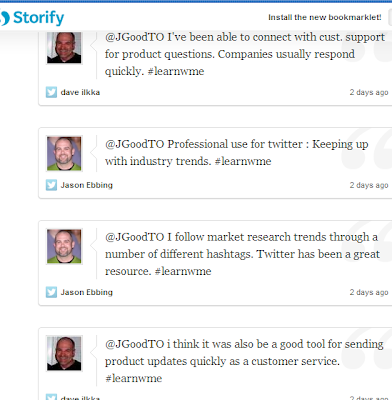
During my last #learnwme chat, many other options were shared and agreed on, such as checking industry trends and improving customer service:

As well as the back channel communication that takes place at conferences and also keeping the momentum going afterward via Twitter:

Of course, networking, sharing and following those in your industry that you admire or want to learn from are valuable uses professionally for Twitter as well:

Honestly, I believe the possibilities that exist when you use Twitter for professional development and opportunities are basically limitless. As I pointed out during our most recent chat, make sure that your participation with others on Twitter is always a two-way street: Don't just give, and don't just receive. The exceptional value I've experienced from using Twitter thus far has come about because I have helped others just as much as they have helped me. Show a willingness to be helpful to others and you'd be amazed at how helpful the Twitter community is back in return.
Here's a great link from WikiHow that I shared with the #learnwme chat partcipants that provides some more advice on using Twitter as a Professional.
The most common advice I give people is to just jump in and get your feet wet. That's what worked for me. The more I used Twitter, the more I recognized its value and the more value I received. Learning, networking, collaborating, sharing, teaching - it's all there and in great abundance. So, what are you waiting for?
Tuesday, October 16, 2012
Social Media and Backchannel Learning
When I got my iPhone, one of the very first apps I put on it was Evernote which I still use every single day. It often serves as my own personal Wikipedia of articles and learning. And the iPhone itself has become a tool I rave about because of how it has helped me increase productivity, connect with others and learn new and wonderful things.

Therefore, I am always disappointed when a trainer or facilitator begins their session or workshop with this request: "Please turn off your phones and mobile devices before we get started."
In Dave Kelly's article, Backchannel Learning in an Organizational Setting, he confronts this common occurrence and explains why these trainers and facilitators should stop fighting the technology wave that has already arrived and embrace it instead. And I completely agree.
He writes,
Coming up at the end of this month, I will be tweeting for and from the Canadian Society of Training and Development's 2012 Conference and I can't wait. I, along with many others, will be tweeting the gems we learn for anyone to see via the hashtag, #CSTD2012. As Dave Kelly points out in his article, this backchannel learning is an amazing opportunity despite all the unfortunate resistance to it.
Please leave your comments below.

Therefore, I am always disappointed when a trainer or facilitator begins their session or workshop with this request: "Please turn off your phones and mobile devices before we get started."
In Dave Kelly's article, Backchannel Learning in an Organizational Setting, he confronts this common occurrence and explains why these trainers and facilitators should stop fighting the technology wave that has already arrived and embrace it instead. And I completely agree.
He writes,
He goes on to relate another common occurrence that I personally partake in when attending conferences and workshops - using Social Media platforms during the sessions to relay what is being learned to others not in attendance. I adore Twitter for this reason (among many others). This fantastic interaction is referred to as 'The Backchannel'.Many teachers, trainers, and presenters have been resisting the use of mobile devices during their sessions. To quote a famous Star Trek line, "Resistance is futile." The influx of smart phones is only going to continue, so resistance only delays the inevitable. It is also shortsighted, as the usage of mobile devices during sessions is not a risk at all; it is an opportunity.Simply put, learners are now walking into your session carrying the ultimate engagement tool right in their pocket.
Coming up at the end of this month, I will be tweeting for and from the Canadian Society of Training and Development's 2012 Conference and I can't wait. I, along with many others, will be tweeting the gems we learn for anyone to see via the hashtag, #CSTD2012. As Dave Kelly points out in his article, this backchannel learning is an amazing opportunity despite all the unfortunate resistance to it.
I embrace and encourage the use of smartphones, Social Media and backchannel learning whenever and wherever possible. How about you? What experiences have you already had and what were the outcomes?In addition to the content shared by those organizational employees in attendance, non-attendees can also learn from the content shared by everyone else attending the conference. For larger conferences, there could be hundreds of people sharing their learning via the backchannel.It is in this open sharing that the true power of the backchannel emerges. You can definitely get an understanding of the themes, trends, and concepts being shared at a conference by reviewing the postings of attendees shared through the backchannel.
Please leave your comments below.
Thursday, October 11, 2012
Twitter: In the Classroom
On Monday, June 13, 2011, I came across a video on YouTube that basically became my first step into an amazing journey. The video, "The Twitter Experiment - Twitter in the classroom", shows how Dr. Rankin, professor of History at UT Dallas, uses Twitter to great effect with her students.
I remember when I first watched this, sitting in my desk chair in amazement. I marvelled at her creativity, ingenuity and ability to engage her students with the content in a way they enjoyed and enhanced their learning and retention. Brilliant.
Since then, I've been researching, planning and developing ways in which Social Media platforms like Twitter and increasingly ubiquitous devices like the iPhone can create amazing learning opportunities for adults.
So, come and join me on this incredibly exciting journey! Take a look at where I took my first step....
I remember when I first watched this, sitting in my desk chair in amazement. I marvelled at her creativity, ingenuity and ability to engage her students with the content in a way they enjoyed and enhanced their learning and retention. Brilliant.
Since then, I've been researching, planning and developing ways in which Social Media platforms like Twitter and increasingly ubiquitous devices like the iPhone can create amazing learning opportunities for adults.
So, come and join me on this incredibly exciting journey! Take a look at where I took my first step....
Subscribe to:
Posts (Atom)